Pakistan allocated Rs838 billion to the Benazir Income Support Programme for fiscal year 2026-27. That’s a 17 percent jump from the Rs716 billion set aside the year before, announced by Finance Minister Muhammad Aurangzeb during his June 12, 2026 budget speech and passed by the National Assembly on June 23, 2026. It’s the largest single allocation BISP has received since it launched in 2008. This guide breaks down where that money comes from, how the budget has grown year by year, and what the current allocation actually pays for.
Where BISP’s Money Comes From
BISP isn’t funded by a separate tax or levy. Its budget comes from Pakistan’s federal budget, approved each June as part of the annual Finance Bill. The Finance Division sets the allocation, and Parliament passes it alongside every other government expense.
International commitments shape the number too. Pakistan’s Extended Fund Facility program with the IMF includes specific social-protection targets, and the Fund has pushed for a well-funded, better-targeted BISP even as other subsidies get trimmed, according to Dawn’s June 2026 report on the IMF’s revenue and spending targets for FY2026-27. The World Bank has also studied BISP’s design and impact for years, though its role is technical and advisory rather than a direct source of the yearly budget line.
BISP Budget Growth: Year by Year
BISP’s allocation has climbed nearly every year since it started, though the pace of growth has shifted with inflation and government priorities.
- FY2012-13: Rs70 billion
- FY2013-14: Rs75 billion
- FY2014-15: Rs97 billion
- FY2015-16: Rs102 billion
- FY2016-17: Rs115 billion, as recorded in Economic Survey 2016-17 and reported by Profit Pakistan Today
- FY2022-23: Rs408 billion
- FY2023-24: Rs450 billion, later revised upward to Rs471 billion, a 15 percent increase, per Business Recorder’s budget coverage
- FY2024-25: roughly Rs592-599 billion
- FY2025-26: Rs716 billion, about a 20 percent rise, confirmed in Pakistan’s own IMF disclosures and reported by The Nation
- FY2026-27: Rs838 billion, a 17 percent rise, per APP and Dawn’s June 2026 budget coverage
Growth hasn’t been a straight line every year. Some years saw a 15 percent bump, others closer to 20 percent, depending on inflation and IMF program terms.
What the Rs838 Billion Actually Funds
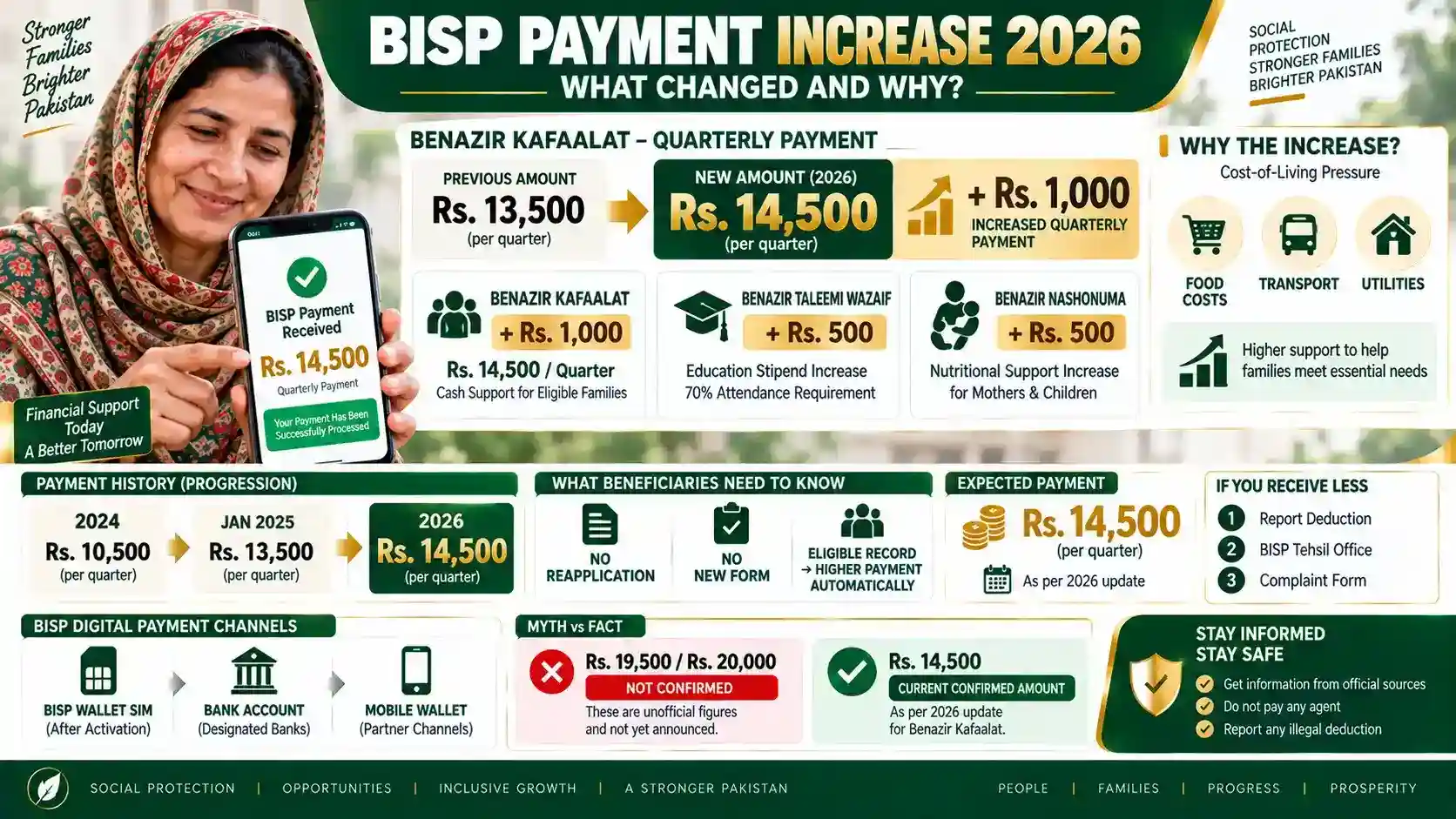
This year’s allocation covers the quarterly unconditional cash transfer under Kafaalat, the Benazir Taleemi Wazaif education stipend, the Ramzan Package, and the Benazir Nashonuma nutrition programme for mothers and young children. It also funds BISP’s digital push — free SIMs, wallet accounts, and biometric verification for beneficiaries under the government’s Digital Social Protection Wallets initiative, according to a briefing published on the President’s official website.
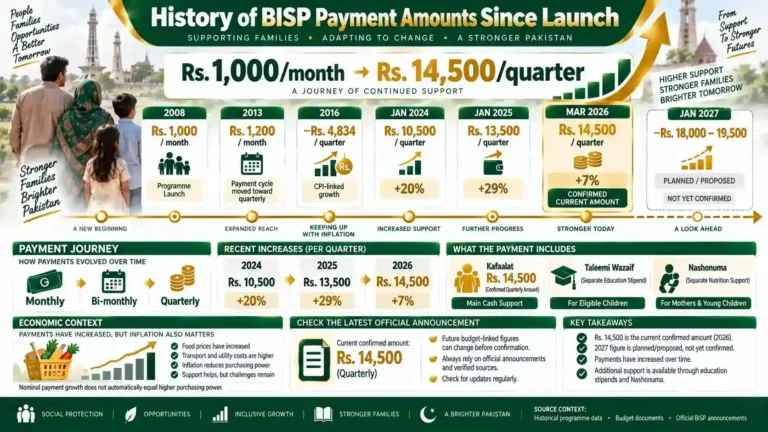
The Kafaalat quarterly stipend itself rose from Rs13,500 to Rs14,500 starting January 2026, a change Profit Pakistan Today and Pakistan Observer both reported ahead of the FY2025-26 budget. Pakistan has since committed to the IMF to raise that stipend again, to Rs18,000 per family, starting January 2027, as Dawn’s report on the IMF’s third EFF review detailed. Roughly 10 million households currently receive support under the programme.
How Much Has BISP Spent Since 2008
BISP’s cumulative reach gives a clearer picture than any single year’s number. From its October 2008 launch through fiscal year 2021-22, the programme disbursed Rs1,326.27 billion to a cumulative 71.91 million beneficiary instances, according to Economic Survey 2021-22 data reported by Business Recorder.
More recently, a World Bank study found that BISP supports over 10.3 million families today, covering close to 24 percent of all Pakistani households, per a briefing summary published on the President’s official website. The same study found that every rupee BISP disburses generates roughly Rs2.34 in real income through local economic activity. In practice, most of BISP’s year-to-year budget growth tracks inflation adjustments to the quarterly stipend and IMF-linked commitments, rather than a straightforward expansion in beneficiary numbers alone.
What Independent Research Says
The World Bank’s multiplier finding is the clearest independent data point on BISP’s economic return, and it comes from a government-cited World Bank study rather than BISP’s own reporting. Separately, BISP’s administrative running costs have been reported at under 1 percent of its total budget, according to coverage in The News, meaning most of the allocated money reaches beneficiaries directly rather than covering overhead.
Is BISP’s Budget Likely to Keep Growing?
Yes, and the reasons are largely locked in already. Pakistan’s IMF program ties future BISP funding to specific stipend targets, including the Rs18,000 quarterly payment due by January 2027, so budget growth over the next cycle is close to a fixed commitment rather than a guess. Inflation adjustments will keep pushing the nominal number up even without new beneficiaries added.
For a plain look at what this funding means for your own household, My8171’s Benazir Income Support Programme portal walks through eligibility checks, payment status, and registration steps in one place.
FAQs
How much is BISP’s budget for 2026-27?
Pakistan allocated Rs838 billion to BISP for fiscal year 2026-27. This is a 17 percent increase over the Rs716 billion allocated the year before, announced by Finance Minister Muhammad Aurangzeb on June 12, 2026.
Where does BISP’s funding come from?
BISP is funded through Pakistan’s annual federal budget, not a dedicated tax. The IMF’s Extended Fund Facility program also shapes the allocation, since Pakistan has committed to specific social-protection spending targets under that program.
How much has the BISP budget grown since 2008?
BISP’s budget rose from Rs70 billion in FY2012-13 to Rs838 billion in FY2026-27. Growth accelerated sharply after FY2022-23, largely due to inflation and IMF-linked stipend increases rather than one single policy change.
Is the quarterly BISP payment going up again?
Yes. The Kafaalat quarterly stipend rose to Rs14,500 in January 2026, and Pakistan has committed to the IMF to raise it further to Rs18,000 starting January 2027, according to Dawn’s reporting on the IMF’s staff review.
How many families does BISP support?
A World Bank study found BISP supports over 10.3 million families, roughly 24 percent of all households in Pakistan, according to a summary published on the President’s official website.
Does the IMF control BISP’s budget?
Not directly, but the IMF’s loan program sets specific targets BISP’s budget must meet, including stipend levels and beneficiary coverage. Pakistan’s own budget documents and IMF disclosures confirm these targets are negotiated as part of the country’s Extended Fund Facility.
Will BISP’s budget increase again next year?
Based on the current IMF program, further increases are likely, since Pakistan has already committed to a higher quarterly stipend by January 2027. The exact FY2027-28 figure will depend on that year’s federal budget announcement, typically presented each June.