
BISP currently benefits ~10 million households under its core Kafaalat cash transfer, with expansion toward 10.2 million planned. That number has grown steadily since the programme started in October 2008, when it reached only a fraction of that count. This guide breaks down how BISP’s beneficiary numbers have grown year by year, what today’s figures actually cover, and why different official sources sometimes report slightly different totals.
BISP Beneficiary Numbers: Year by Year
BISP’s reach has expanded almost every year since it began, though the pace picked up sharply after 2020.
- FY2012-13: 3.73 million beneficiaries, as reported by Profit Pakistan Today citing Economic Survey 2016-17 data
- FY2014-15: 5 million beneficiaries
- FY2016-17: roughly 5.4 million beneficiaries
- FY2020-21: 7 million beneficiaries, per Economic Survey 2021-22 figures reported by Business Recorder
- FY2021-22 (as of March 31, 2022): 9.1 million beneficiaries
- November 2024: 9.3 million eligible households, described by BISP Chairperson Senator Rubina Khalid as the programme’s largest database after NADRA’s, per official BISP Press Release No. 146
- January 2026: 10 million women had digital wallet accounts opened for the first time, per BISP Press Release No. 01
- April 2026: over 10 million women benefiting under Benazir Kafaalat, per BISP Press Release No. 31
- June 2026: 12 million households receiving quarterly Kafaalat cash assistance, per the President’s Office briefing to the First Lady
Since its 2008 launch through fiscal year 2021-22 alone, BISP disbursed a cumulative Rs1,326.27 billion across 71.91 million beneficiary instances, according to Economic Survey 2021-22 data reported by Business Recorder. That figure counts every payment cycle over the years, not unique households, so it runs far higher than any single year’s beneficiary count.
Why the Numbers Don’t Always Match
Readers researching BISP often notice that official sources report different totals in the same year. This isn’t a contradiction. BISP tracks several distinct counts: households in its eligible database, women actively receiving Kafaalat payments, and children enrolled in linked programmes like education or nutrition stipends. Each of these is a real, separately tracked number.
In practice, the gap between the 9.3 million figure from late 2024 and the 12 million figure from mid-2026 likely reflects genuine enrollment growth plus a shift in what’s being counted — eligible households in the database versus women currently drawing a Kafaalat payment. Official BISP press releases don’t always specify which metric they’re citing, so treating each number as tied to its stated date and source, rather than comparing them directly, gives a more accurate picture.
What Today’s Numbers Actually Cover
BISP isn’t one single beneficiary list. It runs several linked programmes, each with its own count.
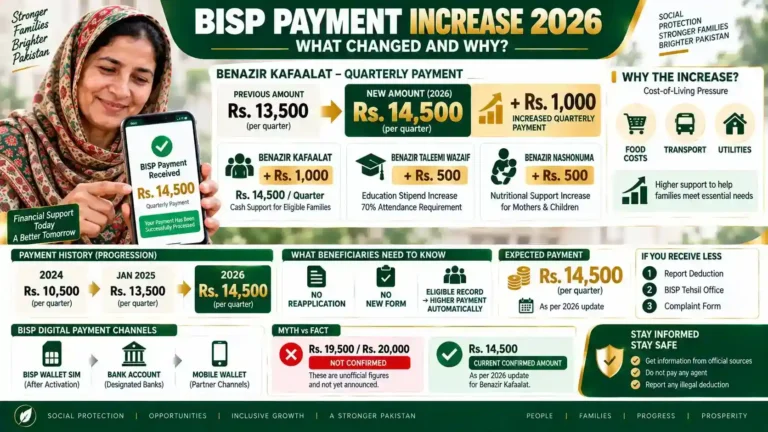
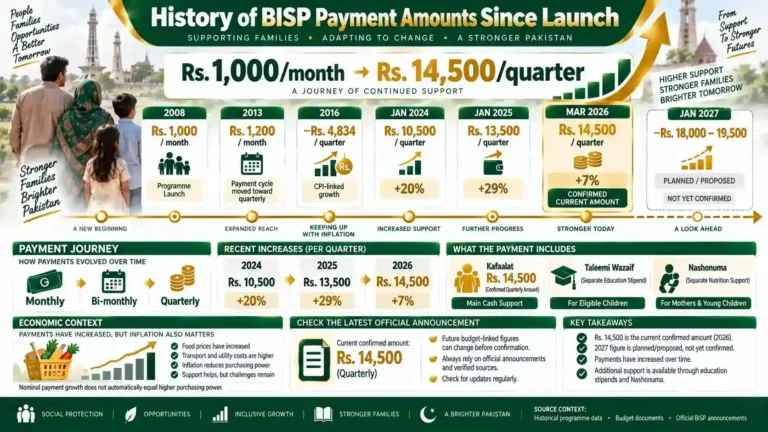
Benazir Kafaalat, the core unconditional cash transfer, reaches ~10 million households currently, with expansion toward 10.2 million planned. The quarterly stipend rose from Rs13,500 to Rs14,500 starting in the quarter beginning March 2026, according to BISP Press Release No. 20.
Benazir Taleemi Wazaif, the education stipend for children of Kafaalat families, supports more than 12 million children, according to BISP Press Release No. 45, issued June 8, 2026. The same release noted that 503 of these students secured A+ grades in their matriculation exams.
Benazir Nashonuma, the nutrition programme for pregnant women and young children, supports more than 2.2 million women and children. BISP has linked this programme to a 22 percent reduction in child stunting, per the same June 2026 press release.
Benazir Hunarmand, the newer skills-training initiative, had enrolled 6,000 young people as of June 2026, according to the same source. It’s the smallest of BISP’s programmes by beneficiary count, reflecting its early stage compared to the decade-old Kafaalat programme.
The Bigger Registry Behind the Numbers
BISP’s beneficiary count draws from a much larger database. The National Socio-Economic Registry holds data on 38.7 million households nationwide, and 23 million of these have updated their information through the Dynamic Registry process, according to a briefing published on the President’s Office website. A recent recertification exercise identified more than 3.5 million additional families as potentially eligible for the programme.
This registry size explains why BISP’s active beneficiary count keeps climbing even without a headline policy change. As households update their records or get surveyed for the first time, some move from “in the registry” to “actively receiving payments.”
What Independent Research Says
A World Bank study found that BISP supports over 10.3 million families, covering close to 24 percent of all Pakistani households, according to a summary published on the President’s Office website. The same study found that every rupee BISP disburses generates roughly Rs2.34 in real income through local economic activity, a multiplier effect independent of the raw beneficiary count.
In practice, official beneficiary counts differ depending on whether BISP is measuring households in its eligible database, women currently drawing a Kafaalat payment, or children enrolled in a linked programme like Taleemi Wazaif — the three numbers are related but never meant to be interchangeable.
Is BISP Still Expanding?
Yes. BISP’s Chairperson has stated the programme’s scope continues to grow on the instructions of President Asif Ali Zardari, with international recognition from the World Bank and the Asian Development Bank, according to a BISP press statement made during a visit to Mardan. Pakistan has also committed to the IMF to raise the Kafaalat quarterly stipend further, to Rs18,000, starting January 2027, which is expected to bring more currently-registered households into active payment status.
If you want to check whether your own household falls within these numbers, My8171’s Benazir Income Support Programme portal covers eligibility checks, CNIC-based status lookups, and registration steps in one place.
FAQs
How many people does BISP currently help?
BISP currently provides Kafaalat cash assistance to ~10 million households, with expansion toward 10.2 million planned. Millions more receive support through linked programmes like Taleemi Wazaif and Nashonuma.
Why do different sources give different beneficiary numbers for BISP?
BISP tracks several distinct figures — households in its eligible database, women actively receiving payments, and children enrolled in specific programmes. These numbers come from the same organization but measure different things, so they rarely match exactly.
How many children benefit from Benazir Taleemi Wazaif?
More than 12 million children receive education stipends under Benazir Taleemi Wazaif, according to BISP Press Release No. 45, issued in June 2026.
How has BISP’s beneficiary count grown since it started?
BISP began with a much smaller beneficiary base in 2008 and reached 3.73 million by FY2012-13, 7 million by FY2020-21, and over 12 million households by mid-2026. Growth accelerated notably after 2020.
Does BISP’s beneficiary count include the Nashonuma nutrition programme?
Nashonuma is tracked separately from Kafaalat. It supports more than 2.2 million women and children as of June 2026, and BISP links it to a 22 percent drop in child stunting rates.
How many households are eligible for BISP but not yet enrolled?
A recent recertification exercise identified more than 3.5 million additional families as potentially eligible, out of a National Socio-Economic Registry covering 38.7 million households in total, per a President’s Office briefing.
Will BISP’s beneficiary numbers keep growing?
Likely yes. BISP’s Chairperson has stated the programme’s scope is actively expanding, and Pakistan’s IMF commitments include stipend increases through January 2027 that are expected to move more registered households into active payment status.