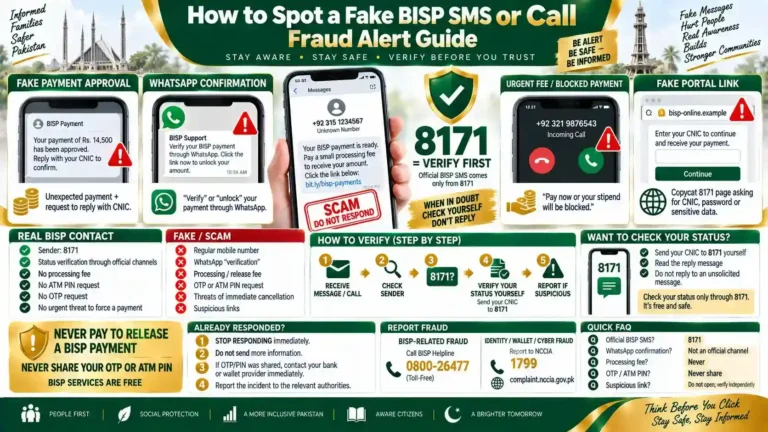
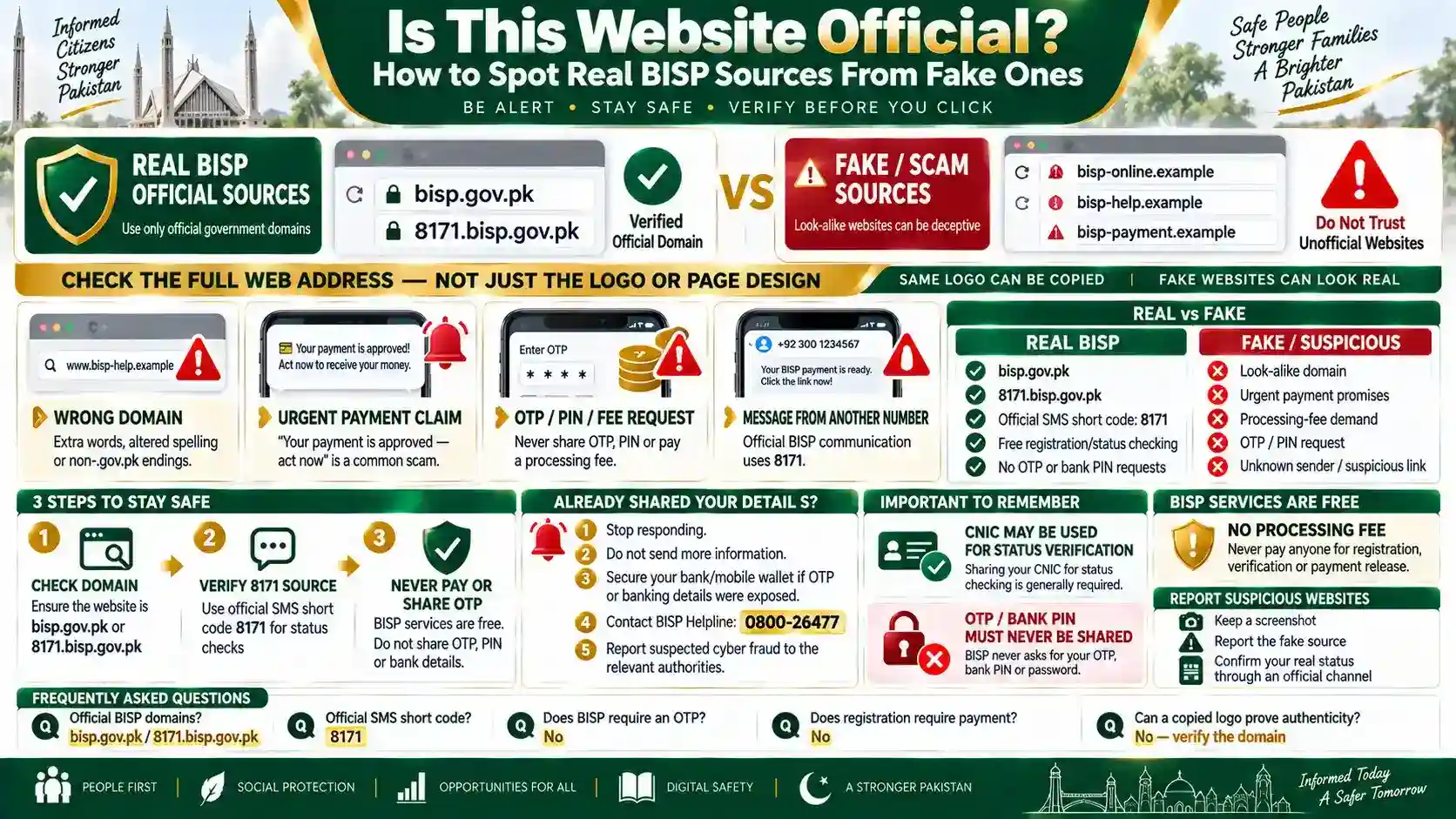
The clearest sign of a fake BISP website is the web address itself. Only two domains are official: bisp.gov.pk and 8171.bisp.gov.pk. Any site with an extra word, a different ending, or a slightly altered spelling claiming to represent BISP is not genuine. Scammers regularly copy the layout, colors, and even the logo of the real site, so appearance alone won’t confirm it. This guide covers the exact patterns fake BISP sites and messages use, how to confirm a source is real, and what to do if you’ve already shared your CNIC somewhere you shouldn’t have.
Common Patterns Fake BISP Sites and Messages Use
Fake BISP sources tend to repeat the same few patterns. Knowing them makes a fake source easier to spot on sight.
Domain Names That Don’t Match
Genuine BISP pages live only on bisp.gov.pk or 8171.bisp.gov.pk. Fake sites often add extra words, like “bisp-helpline” or “bisp-online,” or swap the ending to .com, .net, or .info instead of .gov.pk. BISP has stated that its official website and social media accounts are where users should go for authentic information about its programmes. Before entering any personal detail, check the full address bar, not just the page title. pakistantoday
Urgency and “Approved Payment” Claims
Fake messages often claim a payment has already been approved and needs quick action to release it. BISP has said that real messages never promise financial assistance without proper verification and documentation first. Any message pushing you toward a decision within minutes is a strong signal it did not come from BISP.
Requests for CNIC, OTP, or Banking Details
Real BISP communication never asks for your OTP, bank PIN, or a “processing fee” to release a payment. Registration and status checks through the official 8171 SMS service and web portal are always free. If a message or caller asks for money before help, that alone confirms it is fraudulent.
Messages From Numbers Other Than 8171
Official BISP communication is sent only from the short code 8171. Per bisp.gov.pk, official communication from BISP only originates from the number 8171, and beneficiaries are advised not to trust messages from any other number. This applies to SMS, WhatsApp, and phone calls alike — BISP does not run an official WhatsApp line.
How To Confirm a BISP Source Is Genuine
A few checks take less than a minute and remove the guesswork.
- Check the exact domain in the address bar: bisp.gov.pk or 8171.bisp.gov.pk, nothing else.
- Confirm any SMS sender shows as 8171, not a regular mobile number.
- Cross-check your status directly on the 8171 web portal, rather than clicking a link from an unsolicited message.
- Remember that no genuine step in the process ever requires payment.
Bookmark the portal once you’ve verified it, and use that saved link for future checks instead of searching again. In practice, most fake BISP pages give themselves away within the first two lines, either through a fee request or a domain that doesn’t end in .gov.pk.
What To Do If You Already Shared Your CNIC or OTP
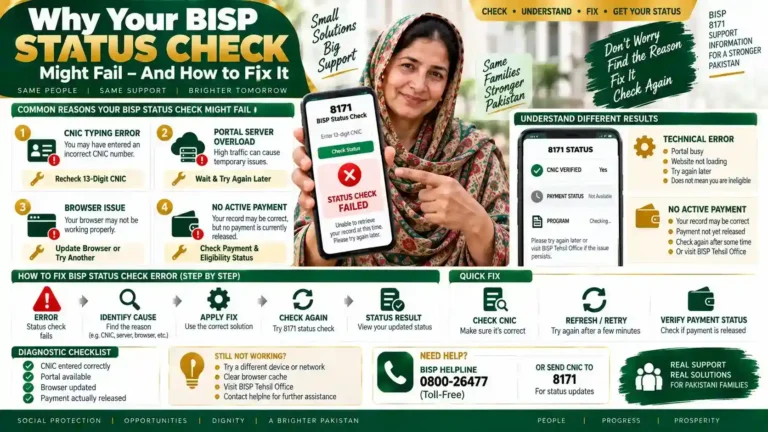
Stop responding to the site or number immediately, and do not send any further details. If you shared an OTP or banking information, contact your bank or mobile wallet provider right away to secure the account. Per bisp.gov.pk, the toll-free helpline 0800-26477 is the channel for reporting exactly this kind of complaint. Call it to report what happened and confirm your real status.
Where To Report a Fake BISP Website
Report the fake site or message to the BISP helpline at 0800-26477 first, since this connects you to a genuine status check as well as a complaint record. You can also report it to Pakistan’s FIA Cyber Crime Wing, reachable at 1991. Keep a screenshot of the fake site or message before reporting; it helps trace the pattern.
Frequently Asked Questions
What is the only official BISP website?
The only official BISP domains are bisp.gov.pk and 8171.bisp.gov.pk. Any other domain claiming to be BISP, even with similar wording, is not genuine. Always type the address directly instead of clicking a shared link.
Does BISP ever charge a fee to check status or register?
No, checking your status and registering with BISP is always free. Anyone asking for a “processing charge” is not a genuine BISP source. Report the request instead of paying it.
How do I know if an SMS is really from BISP?
A genuine BISP SMS always arrives from the short code 8171, never a regular mobile number. It will not ask you to call back or click a link for urgent action. If either happens, treat the message as fake.
What should I do if I already entered my CNIC on a fake site?
Stop using that site immediately and avoid entering any further details. Contact your bank or mobile wallet provider if you also shared banking or OTP information. Then call the BISP helpline at 0800-26477 to confirm your real status and report the incident.Can I trust BISP updates shared on WhatsApp or Facebook?
Treat WhatsApp forwards and unofficial Facebook pages with caution, since BISP does not run an official WhatsApp line. Verify anything you see there against bisp.gov.pk or the 8171 web portal before acting. Official BISP social accounts are linked directly from the real website.
What number should I call to report a fake BISP website?
Call the BISP helpline at 0800-26477 to report a fake site and check your real status in the same call. For online fraud specifically, Pakistan’s FIA Cyber Crime Wing can also be reached at 1991.
Is 8171.bisp.gov.pk the same as the 8171 SMS service?
Yes, both run under the same 8171 system. The SMS service works by texting your CNIC to 8171, while the web portal lets you check the same information online. Neither one ever asks for payment or your OTP.