BISP began in July 2008 as a single unconditional cash transfer program. Nearly two decades later, it has grown into a multi-program system covering education stipends, nutrition support, and seasonal relief, all checked through one digital system. This guide traces that growth year by year, from a modest quarterly payment to today’s 8171-based infrastructure.
2008: The Founding Year
The Unconditional Cash Transfer program — what beneficiaries now know as Kafaalat — was initiated in 2008, according to bisp.gov.pk’s own program record. It became, in the agency’s own words, the largest single cash transfer program in Pakistan’s history. The program was named after Benazir Bhutto and began as a straightforward quarterly cash payment to poor households, well before any of BISP’s other schemes existed.
2012–2020: Expanding Beyond Cash
BISP piloted its first education stipend program in five districts in November 2012, according to bisp.gov.pk. That initiative — later known as Taleemi Wazaif — expanded steadily: to 32 districts by 2015, 50 districts by 2018, 100 districts by January 2020, and every district in the country by July 2020, per the same official record.
Alongside this, BISP undertook a major overhaul of its own data. A “dynamic” National Socio-Economic Registry (NSER) survey was piloted starting in 2016, with a national rollout beginning in September 2017, according to Press Information Department releases from that period. By the time this update completed, BISP had collected data on 35 million households, according to bisp.gov.pk’s own account of the NSER rollout.
In August 2020, BISP designed the Nashonuma program as a Conditional Cash Transfer aimed at pregnant and lactating women and children under two, according to pass.gov.pk. This added a nutrition-focused layer to a system that had, until then, been built mainly around cash and education.
2019–2022: The Ehsaas Era
In 2019, the federal government launched Ehsaas, an umbrella covering 115 policies under four pillars: governance reform, safety nets, jobs and livelihoods, and human capital development, according to a Press Information Department release from that year. BISP’s existing programs continued operating, now grouped under this broader Ehsaas branding alongside new initiatives.
The most significant of these new initiatives was Ehsaas Emergency Cash, a one-time COVID-19 relief program that reached 12 million people, according to then-Finance Minister Shaukat Tarin, as reported by Dawn in June 2021. Other Ehsaas-era additions during this period included savings wallets for poor women and a subsidized food program, both tracked in Dawn’s reporting through 2021 and 2022.
2022–Present: Renewed Growth Under BISP Branding
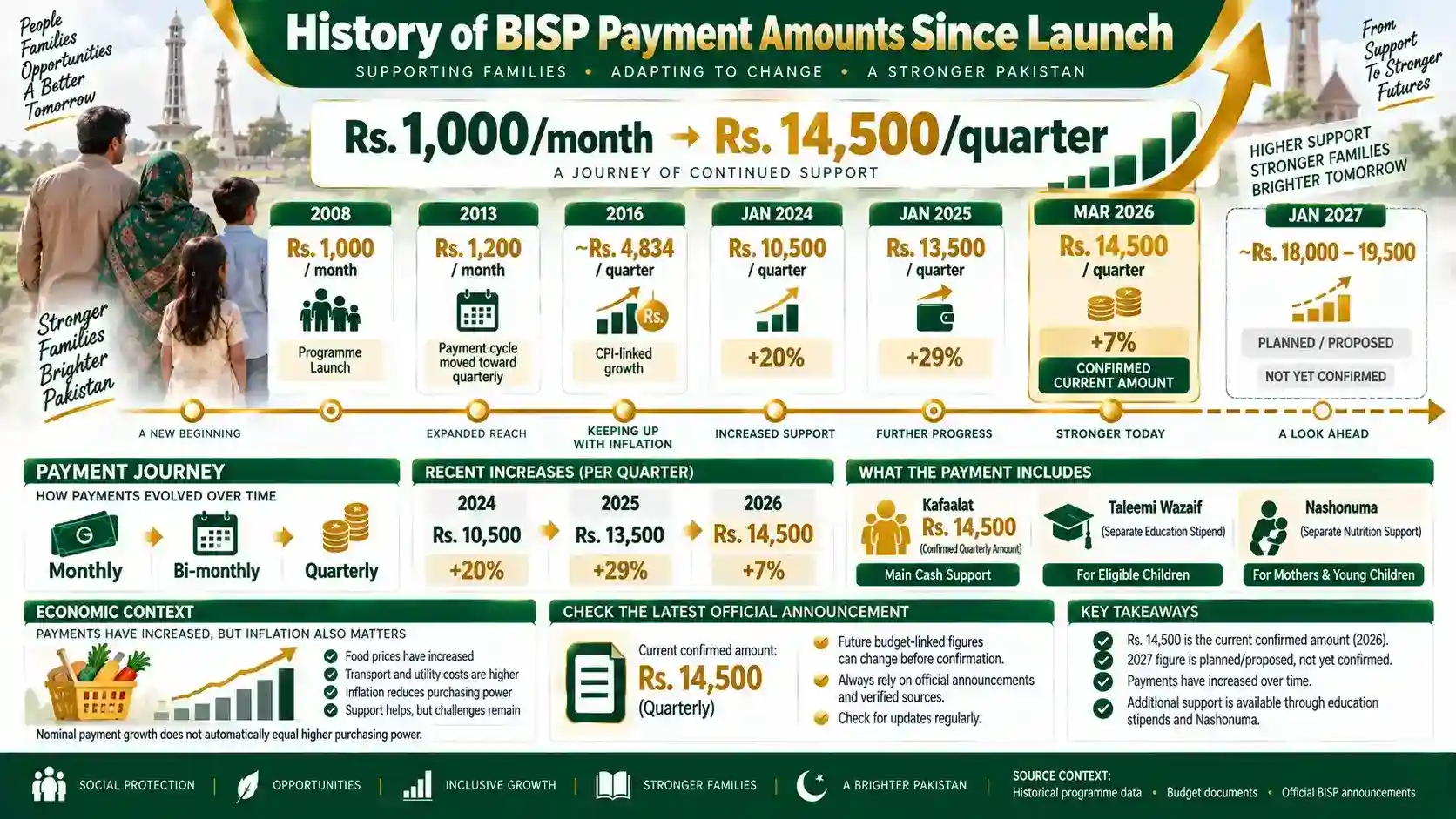
Following the 2022 change in government, public communications shifted back toward BISP’s original “Benazir” naming for its core programs. Stipend amounts rose repeatedly in the years that followed: from Rs 7,000 per quarter in early 2023, to Rs 8,750 after a 25 percent increase announced that August, according to a Press Information Department release, and further still in the years after.
The disbursement system itself also changed. BISP introduced a Digital Wallet payment mechanism, moving away from reliance solely on physical bank branches and campsites, according to a June 2026 bisp.gov.pk press release. That same release noted BISP’s fleet of Mobile Registration Vans had grown from 25 to 32 vehicles, extending registration access to remote areas. Separately, BISP launched a real-time digital dashboard for the Nashonuma program in February 2026, according to ARY News, allowing better tracking of enrollment and disbursement for that scheme specifically.
Where BISP Stands Today
Today, BISP runs as a connected set of programs rather than a single payment. Kafaalat remains the core quarterly cash transfer, reaching roughly 12 million households, according to a government briefing reported by APP. Taleemi Wazaif, Nashonuma, and the seasonal Ramzan Package all run alongside it, each checked through the same CNIC-based system rather than separate portals. What started as one quarterly payment in 2008 is now a full ecosystem, unified under the My8171 BISP information hub.
FAQs
When was BISP founded?
BISP’s core cash transfer program began in 2008. It has expanded steadily since then to include education, nutrition, and seasonal relief programs.
Is the Ehsaas brand still part of BISP today?
The Ehsaas name isn’t actively used as an umbrella brand in 2026. Its core programs continued under BISP’s own “Benazir” naming after 2022.
When did the 8171 digital check system start?
BISP’s move toward digital eligibility and payment checks developed gradually as part of its broader modernization push in recent years. The 8171 SMS service and web portal are now the standard way to check status.
Is BISP still expanding today?
Yes. Recent additions include a Digital Wallet payment system, an expanded Mobile Registration Van fleet, and a dedicated tracking dashboard for the Nashonuma program.
How has the core cash payment changed over time?
The quarterly Kafaalat payment has risen multiple times over the years, most recently reaching Rs 14,500 per household in 2026. Each increase has typically been announced ahead of a specific disbursement cycle.
Does BISP’s history include programs that no longer exist?
Yes. Some Ehsaas-era initiatives, like the COVID-specific Emergency Cash program, were time-limited and are not ongoing today, unlike core programs such as Kafaalat and Taleemi Wazaif.