
The National Socio-Economic Registry, or NSER, is the household database BISP uses to screen every applicant. Your answers in the NSER survey generate the poverty score that decides your eligibility for Kafaalat and related programmes. No online check or document alone can make you eligible without an NSER record behind it. This guide covers what the survey collects, how it turns into your score, and how the registry stays current.
What the NSER Survey Actually Collects
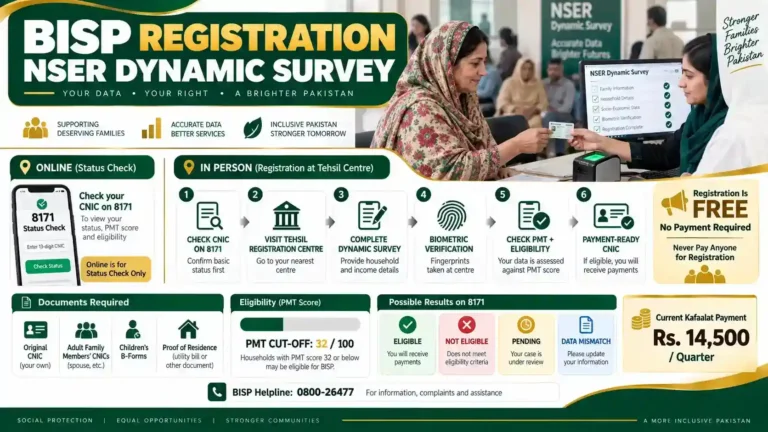
The NSER survey gathers detailed household information in a single interview. Survey teams, or staff at your BISP Tehsil Office, record your household composition, housing conditions, assets, and income sources. BISP first collected this data nationwide in 2010, covering 27 million households across the country (bisp.gov.pk).
Household Composition and Identity
Your CNIC and each child’s B-Form establish exactly who counts as part of your household. This detail decides how your family size factors into your score.
Assets and Living Conditions
Land, livestock, vehicles, and the condition of your housing all feed into the assessment. These details help distinguish genuine poverty from a household that only looks poor on paper.
Income From All Sources
Formal salary, informal work, remittances from abroad, and agricultural income are all recorded. BISP checks these against other data sources during validation.
How the NSER Survey Becomes Your PMT Score
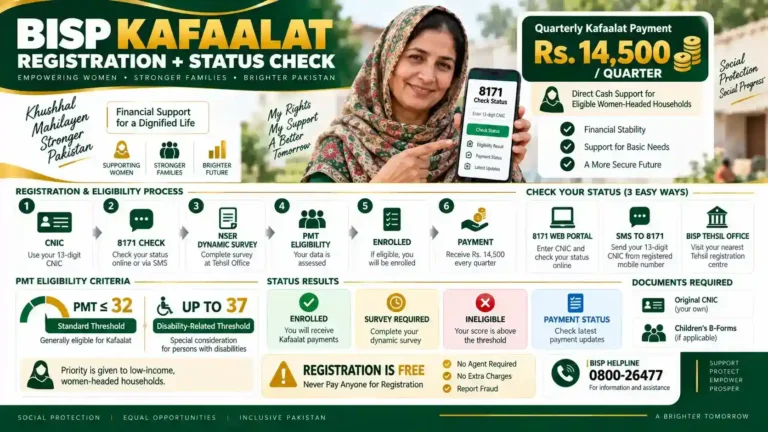
Your NSER answers feed directly into the Proxy Means Test, a statistical model that scores your household from 0 to 100. Households at or below the PMT cutoff, currently 32 and 37 for households with a person with a disability, qualify for Kafaalat and related programmes (bisp.gov.pk). A lower score means your household profile more closely matches the poverty level BISP targets.
Why the NSER Survey Matters for Your Payment
Your NSER record is the one thing BISP checks before releasing any Kafaalat payment. If your survey details go out of date, your payment can be paused until they’re refreshed. This is why keeping your record current matters as much as completing the survey the first time. In practice, most PMT score disputes trace back to outdated NSER details rather than a real change in circumstances.
How the Registry Stays Current: the Dynamic Registry
BISP built the original NSER as a one-time, static survey in 2011 (bisp.gov.pk). In 2016, the design shifted toward a dynamic registry that allows ongoing updates instead of one fixed snapshot (bisp.gov.pk). Under this model, a household cannot request a re-survey within two years of its last one, and beneficiaries who have received stipends for three years must complete a fresh recertification survey (Associated Press of Pakistan, May 2026).
Common Misunderstandings About the NSER Survey
“The NSER survey is the same as registering on the 8171 portal.” It isn’t. The portal only lets you check an existing status by CNIC. The NSER survey itself is a physical interview conducted at your Tehsil Office or by a visiting survey team.
“Completing the survey guarantees a payment.” No. The survey only produces your PMT score. A household above the cutoff completes the same survey as one below it, but doesn’t qualify for Kafaalat.
“Once surveyed, your data never needs updating.” This isn’t correct either. Recertification is required after three years, and any major change in your household should be reported sooner.
If You Haven’t Completed Your NSER Survey Yet
Your eligibility can’t be assessed until your household has an NSER record. Visit your nearest BISP Tehsil Office to find the survey desk and get your household added. For a full breakdown of how your survey score translates into eligibility, see this guide to 8171 PMT score check and eligibility.
FAQs
Is the NSER survey a one-time process?
Not anymore. Since the 2016 shift to a dynamic registry, households can update their details over time rather than relying on a single fixed survey.
Does completing the NSER survey guarantee I’ll get BISP payments?
No. The survey generates your PMT score, and only households at or below the cutoff of 32 (37 for households with a disability) qualify for Kafaalat.
How often do I need to redo my NSER survey?
You can’t request a re-survey within two years of your last one. Beneficiaries who have received stipends for three years must complete a recertification survey.
Can I complete the NSER survey online?
No. The survey is conducted in person, either at a BISP Tehsil Office or by a visiting survey team. The 8171 portal only checks your existing status.
What if my NSER details are outdated?
Outdated details can pause your payment until your record is refreshed. Visit your Tehsil Office to update your household information.
Is there a fee for the NSER survey?
No. The NSER survey and BISP registration are completely free, with no forms or charges at any stage.